
Problem
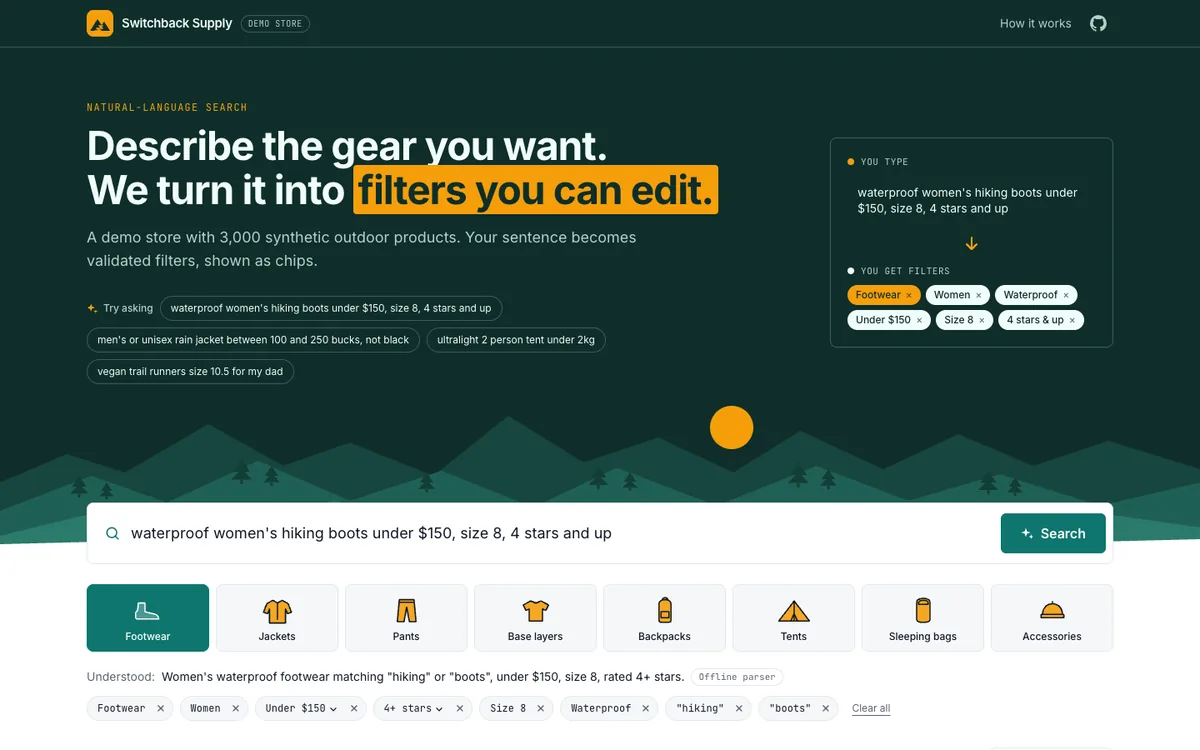
Shoppers describe what they want in sentences, for example "waterproof women's hiking boots under $150, size 8, 4 stars and up". Keyword search handles that badly, and adding AI search that guesses wrong is worse than not having it.
Approach
- One filter schema. A single Zod schema defines every filter the store supports. The model's output has to match it, or it's rejected.
- Editable chips. What the search understood is shown as chips that you can remove or edit, so you can correct it without retyping.
- Honest about gaps. Words that couldn't be mapped to a filter are shown, so it's clear why the results look the way they do.
- Normal search still works. Facets, sorting, pagination, and shareable URLs, like a real storefront.
- Two providers and an offline mode. Claude and OpenAI sit behind one small interface, and an offline parser keeps the demo working without API keys.
- Evals. An evaluation suite runs from the command line and scores the parser per provider.
Stack
Next.js, TypeScript, Zod, the Claude and OpenAI APIs, and Tailwind CSS.
Outcome
A public, runnable version of the natural-language filter pattern I've shipped in production, described in the marketplace search project. You can try the demo, read the code, and run the evals yourself.